

TL;DR:
- Baltimore employers can reduce hiring costs by leveraging local community organizations and educational partnerships.
- Compliance with Baltimore's local hiring law requires posting jobs through MOED for contracts over $300,000 and demonstrating local hiring efforts.
- Building ongoing community partnerships and using local platforms creates a steady pipeline of qualified Baltimore talent.
Hiring in Baltimore doesn't have to drain your budget or stretch your timeline into months of uncertainty. Many local employers overspend on recruiting simply because they rely on national job boards or out-of-state agencies that don't understand the Baltimore market. The good news is that this city has a rich network of community organizations, schools, workforce programs, and local platforms built specifically to connect employers with qualified candidates. This guide walks you through practical, step-by-step methods to find top Baltimore talent faster, stay compliant with local hiring laws, and keep your cost per hire well below the national average.
Table of Contents
- Understand Baltimore's local talent landscape
- Meet local hiring laws and compliance requirements
- Choose your approach: direct recruiting vs. staffing agencies
- Build sustained talent pipelines with community partnerships
- Why local-first strategies still outperform in Baltimore hiring
- Level up your Baltimore hiring with local partners
- Frequently asked questions
Key Takeaways
| Point | Details |
|---|---|
| Map local talent sources | Community organizations and schools offer direct connections to cost-effective Baltimore talent. |
| Stay legally compliant | Following Baltimore's hiring laws avoids delays and ensures qualified local candidates get priority. |
| Optimize your sourcing | Choose direct methods for savings and staffing agencies for speed or specialized skills. |
| Invest in long-term pipelines | Building lasting partnerships with local schools and groups secures a steady stream of talent. |
| Mix strategies for success | Combining different hiring approaches meets urgent needs and builds sustained local advantage. |
Understand Baltimore's local talent landscape
Baltimore's workforce is more layered than most employers realize. The city has strong talent pools in healthcare, logistics, construction, hospitality, and technology, fed by institutions like Johns Hopkins, the University of Maryland, Morgan State University, and Baltimore City Community College. Before you post a single job listing, it pays to map where your ideal candidates actually are.
Local employers often overlook the most cost-effective channels. Community organizations, workforce development nonprofits, and neighborhood employment centers regularly place job-ready candidates at little to no cost. The Baltimore DGS hiring program recommends that employers leverage community partnerships with schools, chambers of commerce, and organizations for internships and job fairs to build talent pipelines and reduce costs.
Here's a quick overview of Baltimore's main hiring channels:
| Channel | Average cost | Pros | Cons |
|---|---|---|---|
| Community organizations | Low to free | Pre-vetted candidates, local focus | Slower pipeline build |
| School partnerships | Low to free | Entry-level talent, internship ready | Less experienced |
| Job fairs | Low | High volume, face-to-face screening | Time-intensive |
| Staffing agencies | Moderate to high | Speed, specialization | Higher cost per hire |
| Local job platforms | Low | Targeted, Baltimore-specific | Requires active posting |
For employers with recurring hiring needs, internship programs and youth employment initiatives are among the smartest investments you can make. Programs like YouthWorks place motivated young workers with local businesses at subsidized rates, giving you a pipeline of candidates who already know your industry and culture.
Key channels worth prioritizing:
- Baltimore City Community College workforce programs for skilled trades and healthcare
- Mayor's Office of Employment Development (MOED) for subsidized placements
- Local chambers of commerce for professional and managerial roles
- Baltimore Job Seekers LLC for access to pre-screened Baltimore professionals ready to work
"The employers who consistently hire well in Baltimore are the ones who treat recruiting as a relationship, not a transaction. They show up at job fairs, sponsor internships, and stay connected to local schools year-round."
Building these relationships takes time upfront, but the payoff is a steady stream of qualified applicants who are already invested in staying local.
Meet local hiring laws and compliance requirements
Once you know where to find talent, you need to make sure your hiring process is legally sound. Baltimore has specific requirements that catch many employers off guard, especially those new to city contracts or large-scale hiring.
The most important rule to know: Baltimore City Local Hiring Law applies to contracts over $300,000. If your business holds or is pursuing a city contract at that threshold, you are required to post job openings through MOED before advertising elsewhere, and you must submit employment analyses that demonstrate a priority for hiring Baltimore residents.
Here's what compliance typically involves:
- Posting open positions through MOED's job portal first
- Documenting your outreach efforts to local candidates
- Submitting employment analyses for each covered contract
- Tracking and reporting local hire percentages over the contract term
- Maintaining records for potential audits
Pro Tip: Start your compliance steps at least 30 days before you need to fill a role. MOED's posting and review process takes time, and rushing it often leads to project delays that cost far more than the compliance work itself.
For smaller employers not covered by the $300,000 threshold, it's still worth reviewing the Baltimore employer terms to understand best practices and avoid unintentional violations as your business grows.
Beyond the local hiring law, Maryland state law also governs background checks, ban-the-box requirements (which restrict when you can ask about criminal history), and wage transparency rules. Staying current on all three layers, federal, state, and city, protects you from penalties and builds a reputation as a fair employer in the community.
Compliance isn't just a legal obligation. It's also a competitive signal. Employers who follow local hiring mandates and invest in Baltimore residents tend to attract better candidates, because workers notice which companies are genuinely committed to the community.
Choose your approach: direct recruiting vs. staffing agencies
With your legal foundation in place, the next decision is how you actually source candidates. The two primary options are direct recruiting and staffing agencies, and both have a place depending on your situation.
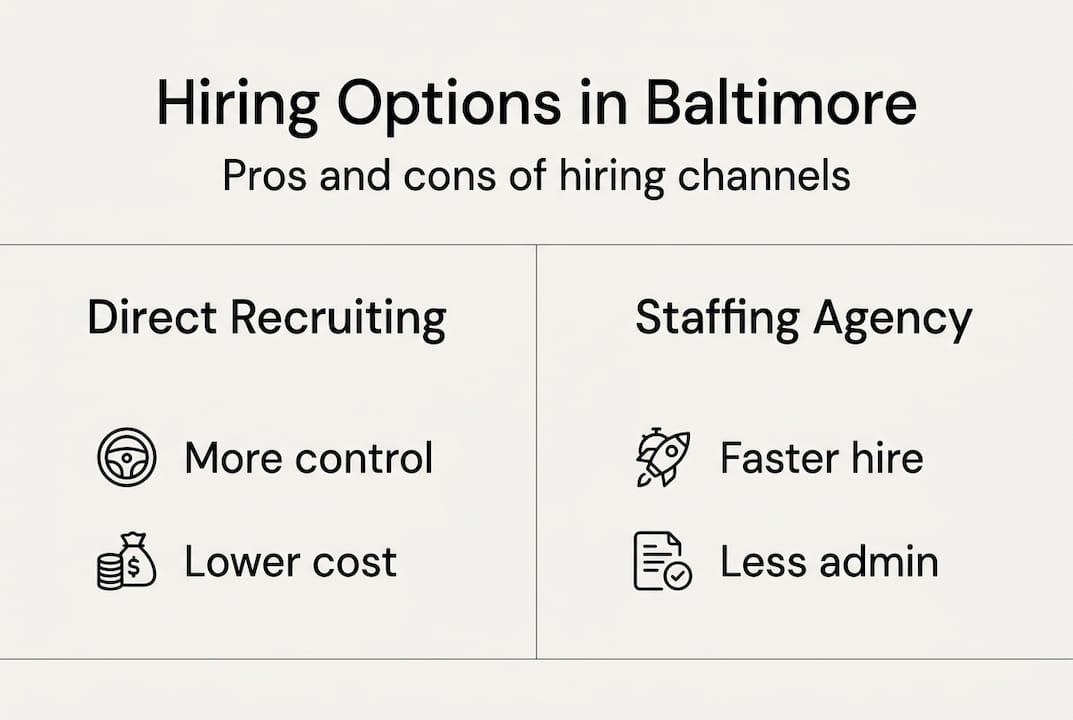
Direct recruiting means you handle sourcing, screening, and hiring internally or through a local platform. It takes more time upfront but typically delivers lower cost per hire and better cultural fit. Staffing agencies handle the sourcing and screening for you, which is faster but more expensive. The median cost per hire across industries sits around $1,340, but agency fees can push that significantly higher for specialized roles.
| Method | Best for | Typical cost | Speed |
|---|---|---|---|
| Direct recruiting | Ongoing roles, culture fit | Lower | Slower |
| Staffing agency | High-volume, specialized | Higher | Faster |
| Hybrid approach | Hard-to-fill roles | Moderate | Moderate |
When to use direct recruiting:
- You're filling roles regularly and want to build an internal talent pool
- The position requires deep cultural alignment or long-term commitment
- You have time to screen candidates and want to control the process
- You want to keep Baltimore staffing costs as low as possible
When to use a staffing agency:
- You need to fill 10 or more roles quickly
- The position requires rare technical skills
- You're testing a new market or department before committing to full-time hires
- You want to explore Baltimore staffing agency services for specialized workforce solutions
Pro Tip: For hard-to-fill roles, blend both approaches. Post directly on local platforms to build awareness and generate inbound interest, while an agency works the specialized candidate market in parallel. This cuts your time-to-fill without doubling your cost.
The smartest Baltimore employers treat these two methods as tools, not competing philosophies. Knowing when to use each one is what separates efficient hiring from expensive guesswork.
Build sustained talent pipelines with community partnerships
Filling today's open roles is one problem. Making sure you always have qualified candidates ready for tomorrow's needs is a different challenge entirely, and community partnerships are the most reliable solution.
Building a pipeline means creating ongoing relationships with institutions that produce the talent you need. This is a long-term play, but the return on investment is significant. Employers who invest in school partnerships, local job fairs, and workforce programs consistently report lower recruiting costs and higher retention rates compared to those who rely solely on reactive job postings.
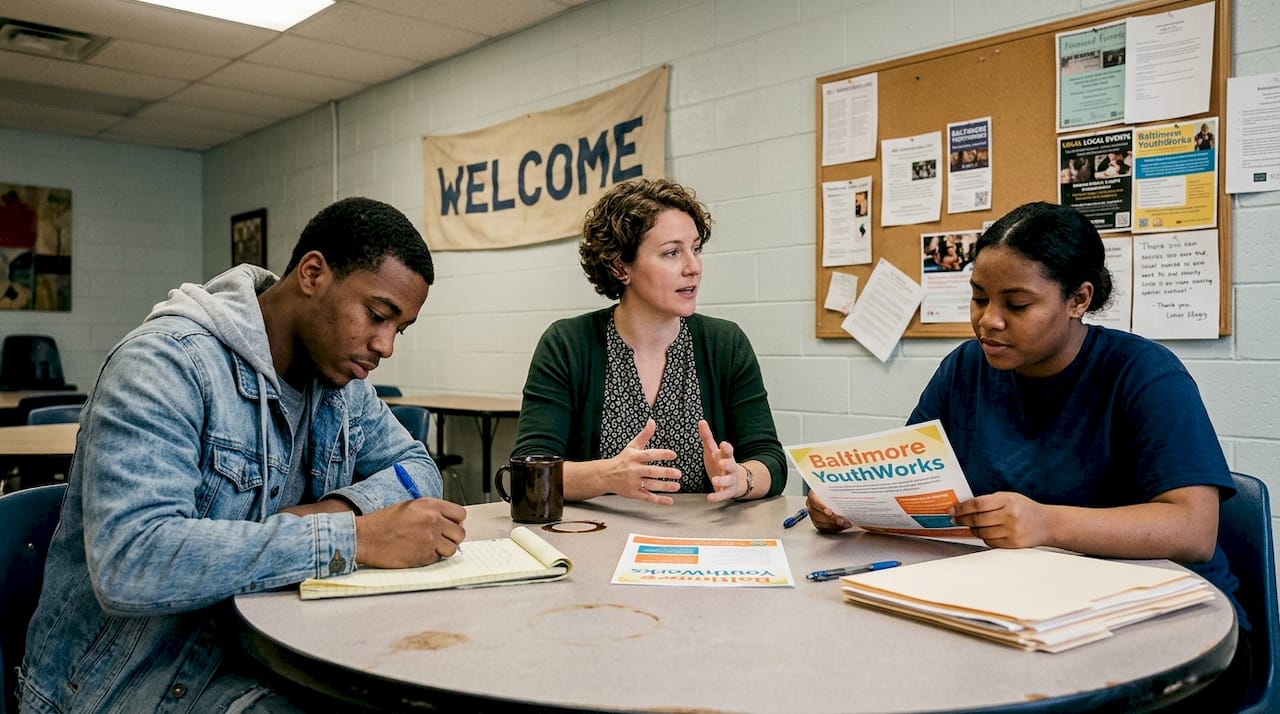
The Baltimore DGS approach to workforce development shows that community-based partnerships with schools, chambers of commerce, and local organizations for internships and job fairs are among the most effective ways to build talent pipelines and reduce costs over time.
Strategies that work well for Baltimore employers:
- Sponsor internship cohorts at Morgan State, Coppin State, or Baltimore City Community College each semester
- Host or attend job fairs organized by MOED, local chambers, or neighborhood workforce centers
- Join industry councils in healthcare, logistics, or construction to stay connected to emerging talent
- Partner with high schools through career and technical education programs for trades and entry-level roles
- Engage Baltimore employers hiring now to understand what's working in your sector
"Employers who show up consistently in Baltimore's community hiring spaces don't just find better candidates. They become the employer of choice in their industry, which means candidates come to them first."
Evaluating a partnership is straightforward. Track how many hires came from each channel over six months, what their retention rate looks like at 90 days and one year, and what the total cost was compared to agency or job board hires. The numbers almost always favor community-sourced candidates.
The key is consistency. Showing up once at a job fair does nothing. Showing up every semester, sponsoring a student, or hosting a workshop builds the kind of trust that makes your company the first call when a strong candidate is ready to work.
Why local-first strategies still outperform in Baltimore hiring
There's a persistent myth that hiring in Baltimore is inherently slow or expensive. In our experience, that's almost never true when employers actually engage with the local ecosystem. The cost and delay problems come from ignoring it.
Employers who rely exclusively on national platforms or out-of-state agencies are essentially paying a premium to bypass the very networks that produce Baltimore's best workers. Local hiring mandates for large contracts exist precisely because the city recognized that local-first hiring produces better outcomes, not just for compliance, but for retention, community investment, and long-term workforce stability.
Direct engagement takes more setup than calling an agency. But the employers we see succeed long-term in Baltimore are the ones who build relationships before they need them. They're not scrambling when a role opens. They already know who to call. That kind of readiness is worth far more than the short-term convenience of a staffing agency fee.
A local-first approach also protects your brand. Baltimore is a tight-knit market. Employers who invest in Baltimore industry staffing and community relationships earn a reputation that attracts talent organically. That reputation compounds over time in ways that no job board budget can replicate.
Level up your Baltimore hiring with local partners
You now have a clear picture of how to source, screen, and hire Baltimore talent efficiently while staying compliant and keeping costs under control. The next step is putting those strategies into action with the right tools.
Baltimore Job Seekers LLC makes it easy to post jobs with Baltimore Job Seekers and connect directly with local candidates who are actively looking. Skip the middlemen and browse our Talent Vault to find pre-screened professionals across Baltimore's top industries. If your needs are more specialized, our industry-specific hiring solutions give you a tailored path to the right candidates without the overhead of a traditional agency. Baltimore talent is here. Let's connect you to it.
Frequently asked questions
What is the fastest way to hire qualified talent in Baltimore?
For urgent needs, staffing agencies fill roles quickly, especially for high-volume or specialized positions. Pairing an agency with a local platform listing can accelerate results even further.
How can I reduce hiring costs in Baltimore?
Community partnerships reduce costs by building steady pipelines through schools and local organizations. Direct recruiting through local platforms also cuts out agency fees and lowers your overall cost per hire.
Are there legal requirements for hiring local talent in Baltimore?
Yes. The Baltimore City Local Hiring Law requires employers with contracts over $300,000 to post through MOED first and submit employment analyses prioritizing Baltimore residents.
What programs support entry-level or youth hiring in Baltimore?
YouthWorks and local internship programs offer subsidized youth labor at minimal cost. YouthWorks costs employers around $2,500 per youth if on the city payroll, or direct pay at minimum wage if hired independently.
How long does it take to fill roles in Baltimore's high-demand industries?
Skilled trades and port-related roles can take significantly longer than average. Baltimore port roles stay open between 87 and 150 days, which makes proactive pipeline building essential for those sectors.
Recommended
- Employer Pricing — Affordable Baltimore Staffing Solutions | Baltimore Job Seekers
- Staffing Agency Baltimore — Post Jobs & Hire Local Talent | Baltimore Job Seekers
- Top-Rated Resume Writing & Staffing Agency in Baltimore | Baltimore Job Seekers
- Baltimore Employers Hiring Now — Local Companies & Open Roles | Baltimore Job Seekers